

Client in Medical Devices
A world-leading medical device company turned to Emids for help designing a cloud-based solution to preserve and protect previously unrecorded patient data.
Those who’ve been in an operating room (or seen one on TV) will recognize the pole-mounted medical monitoring devices displaying patient vitals in real time. What if there was a way to preserve that data to be used at a later date?
Opportunity
A leading medical device manufacturer wanted to develop a way to preserve and contextualize the data, and then make it available for reporting and research. Enter Emids, which was uniquely qualified for its technical and business expertise, and deep healthcare regulatory insight.
Approach
Emids enabled tablets to be connected to medical devices’ Ethernet ports. The tablets could capture heart rate oxygen levels, blood pressure and other vitals exhibited during procedures. Clinicians could then annotate the data via touchscreen and upload it to a private cloud for storage.
The data had to be impregnable. Emids programmed end-to-end encryption, along with carefully controlled access to passwords, and a robust firewall.
Flexibility mattered when it came to client reporting requirements. Emids built in Microsoft’s Power BI Embedded report development tool to enable hospital business analysts to work with clinicians and customize reports as needed.
A different regulatory-related challenge then arose: business analysts aren’t permitted to view patient data. How could they create reports? Again, Emids found a solution. They created a secondary, synchronized database that achieves HIPAA compliance by providing the access analysts need while masking all protected personal information.
Solution
Emids took the project from concept to working prototype in six weeks, on budget and with only two full-time resources. Following trials, the client expects to release a commercial version of the product toward the end of 2017.
Project Details

Regulatory Compliance
Synchronized database to mask PHI and allow business analysts to create reports.

Data Engineering & Data Visualization
Microsoft Power BI Embedded leveraged to allow business analysts to create a flexible reporting solution.

Secure Cloud Integration
Fully encrypted data transfer between the tablet, cloud, and client devices.
Siemens Healthineers – Ultrasound Usability Test
Siemens Healthineers set out to design a new ultrasound machine with Sonographers ease of use in mind. Emids was brought in to help Siemens determine if they met their goal.
Inexpensive, portable and non-invasive, ultrasound systems provide valuable, real-time insight into patients’ bodies. However, hard-to-use equipment can compromise scan quality, regardless of a sonographer’s expertise.
Opportunity
Siemens Healthineers spent time and money creating a new product to bridge this ultrasound usability gap. Then, the company seized on Emids digital technology experience and proven user-experience insight to conduct an objective third-party usability assessment to gauge the new product’s success.
Approach
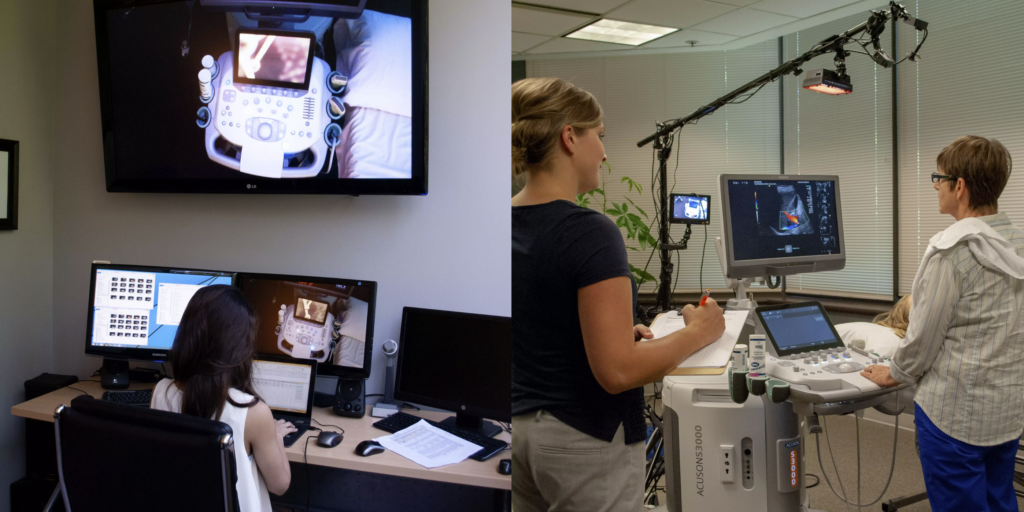
Emids screened and recruited sonographers to operate the new system in a simulated clinical environment. During the test, researchers collected standard usability data and measured task success, error rates and deviations from the expected process. They also gathered ease-of-use ratings and qualitative feedback following each task. Results were presented in accordance with ISO/IEC 25062:2006 Common Industry Format for Usability Test Reports.
Results
The final report validated Siemens’ trust in its new product. Specifically, Emids found that the new equipment:
- Improved user satisfaction
- Reduced overall errors
- Showed high task completion rate
- Generated fewer deviations
- Resulted in high scores for ease of use
The clear evidence of enhanced usability empowered Siemens’ ultrasound sales team when pitching to new and existing clients. Yet the greater value of Emids work for Siemens may be in identifying potential improvements that would further enhance usability in the next generation of ultrasound equipment.
Streamlining Data Collection and Metrics
Leading Global Medical Research Provider Advances Data Collection and Quality Reporting for Surgical Registries
Overview
A multinational Fortune 500 company and the world’s largest provider of biopharmaceutical development and Contract Research Organization (CRO) had contracted with the largest organization of surgeons in the world to improve data collection and reporting for all of their clinical registries.
The registries portals are web applications maintained by research organizations and healthcare providers, which store detailed, anonymized information about patients’ surgical procedure or post-surgery condition. Surgeons affiliated with the organization hire registrars to input the data relevant to patients’ surgical procedure and post-surgical conditions assimilating from various hospital information systems using registry portals.
Making use of the registry data is critical in the national movement to deliver clinical and quality measures across core practice areas, such as surgery. This allows clinicians to improve patient care and, ideally, outcomes. The CRO was charged with the task of combining patient registries with other research organizations and providers, such as hospitals, to provide the organization with comprehensive and accurate reports.
While integration is always challenging when merging disparate data sources, the registries have unique data structure and formats. This made the process of data extraction and transformation highly complex. Currently, much of the reporting is done manually. Finally, the lack of a unified data warehouse at the organization further hindered reporting goals.
Business Opportunity
emids conducted a three-day workshop with the CRO to understand the basics of the systems used in its data storage platform and its overall architecture, along with the functionality and infrastructure of each component. During the process, emids and the CRO determined the need to build a scalable, secure and dynamic platform to store and manage the clinical registry data for the organization of surgeons.
We explored the requirements for migrating historical data from existing registries to the new platform and keeping the clinical data of individuals private for development and quality assurance purposes. We also examined the current challenges of the reporting structure and requirements for achieving future reporting initiatives.
Solution
The platform in development has two components: a unified operational data store (ODS) and a data warehouse. The ODS is used for integrating disparate data from multiple sources, while the data warehouse is needed for long-term storage.
Services We Provided
- A unified web portal to capture data from all clinical registries, with an easy-to-use interface for external vendors’ registrars who must enter and submit the data.
- A unified data warehouse to store the data from various registries in the same structure and format. The system, built on Oracle using Talend ETL (extraction, transformation and loading) software, includes a self-service, web-based business intelligence (BI) application to make it easier for surgeons to review data and reports.
- Automated data migration of existing registries to the new platform, for the organization using emids’ dynamic ETL accelerator tool.
- A data validation tool and process to validate data between clinical registries and the new platform.
- Data de-indentification to ensure that the protected health information (PHI) of patients has been stripped on identifying data right at source.
Platform Infrastructure
- DEV, QA & UAT
Environment Includes a data warehouse, operation data store, master data management and XML type. - Production Platform
Includes a data warehouse, operation data store, master data management and an RDC XML type. - Migration
Includes mapping metadata, migration scripts and a data validation tool. - Source
Includes databases at various registries. PHI elements de-identified at source.
Results
The new unified, clinical data warehouse and portal provides a more efficient, comprehensive system for capturing, merging and delivering quality metrics to the surgical community, with the goal of improving patient care. Along with giving the organization and third-party registrars a single, standard system for submitting data, the new platform provides surgeons and other clinical users with a web-based system for accessing data and running reports, improving their analytics and insight.
- Nearly 40% reduction in testing effort by automating testing of data migration through our data validation tool.
- Increased efficiencies for end users entering data across clinical registries.
- More than 50% reduction in development effort and time from automating migration of data from existing registries to new platform through emids’ dynamic ETL accelerator tool. This will ultimately result in significant cost savings.
- Enhanced analytics & reporting enabled by a self-service BI application capable of providing ad-hoc reporting, cross-registry reporting, etc.